By DENNIS OVERBYE
Published: January 26, 2011
Leapfrogging into the past with the refurbished Hubble Space Telescope, a team of astronomers says it has detected what may be the most distant and earliest galaxy yet found. It is a smudge of light only a tiny fraction of the size of our own Milky Way galaxy, and it existed when the universe was only 480 million years old. Its light has been on its way to us for 13.2 billion years, making it the long-distance champion in an expanding universe.
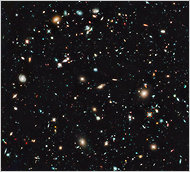 A photo from the Hubble Space
Telescope that is the deepest image of the sky ever obtained in the
near-infrared.
If confirmed, the discovery takes astronomers deep into an era when stars and galaxies were first lighting up the universe and burning their way out of a primordial fog known as the dark ages. The birth rate of stars, they concluded from their observations, increased tenfold in the 200 million years between the time of the newly discovered galaxy and the next earliest known galaxies, which date to 650 million years after the Big Bang - a rate even faster than astronomers had thought.
"This is clearly an era when galaxies were evolving rapidly," the astronomers said in an article published Wednesday in the journal Nature. The team was led by Rychard J. Bouwens of the University of California, Santa Cruz, and Leiden Observatory in the Netherlands, and Garth Illingworth of the University of California, Santa Cruz.
Shortly after the Hubble was refurbished in 2009, Dr. Bouwens and his colleagues observed a patch of sky known as the Hubble Ultra Deep Field in the constellation Fornax with the telescope's new Wide Field Camera 3, which is sensitive to the long-wave "heat" radiation known as infrared. That is important because as galaxies fly away from us in the expanding universe, the light they emit is shifted to longer wavelengths - "red-shifted," in cosmological parlance — the way a receding siren sounds lower.
That data yielded a crop of galaxies dating from 600 million to 800 million years after the Big Bang and a hint of the even earlier galaxy, in which visible light appears to have been shifted all the way into the infrared by a factor of 10, corresponding to a time of only 480 million years after the universe began. After a year of testing and simulations, the team concluded that it was the most primordial galaxy yet found. Spectroscopic observations with the forthcoming James Webb Space Telescope, however, are needed to cement the identification of the smudge as a galaxy.
Meanwhile, the new result fits in well with a picture cosmologists have developed from a variety of sources. In it, the first stars formed around 200 million or 300 million years after the Big Bang, and then the universe continued building more and more stars, reaching a peak of fecundity when it was about two and a half billion years old. Its glory days behind it, the cosmos is now in a middle-age slump.
They leave unclear, however, a longstanding mystery as to how the universe became transparent. As the initial fires of the Big Bang cooled, cosmologists say, the universe was enveloped in a pea-soup fog of hydrogen gas. Over the next billion years, that fog lifted as the hydrogen atoms were stripped of their electrons - ionized - by high-energy radiation, presumably from the early stars, and became transparent. The problem is that astronomers disagree on whether they have been able to find enough stars or galaxies in the very early universe yet to account for the amount of light it would have taken to burn off all the fog.
As a result, some astronomers have suggested that massive black holes could have been partly or mostly responsible for clearing the dark ages. The black holes would have whipped the space around them with high-energy particles and radiation shed by matter in its death throes.
Dr. Bouwens said it was not quite time to resort to black holes as the explanation, however; he noted that many more galaxies could be lurking in the noise just below the limits of detection for the Hubble.
"We really are not probing faint enough with the current Hubble observations to see beyond the tip of the iceberg," Dr. Bouwens said.
The Webb telescope, which is expected to be launched later this decade once NASA figures out how to pay for it, has been designed to find these primordial galaxies and thus illuminate the dark ages.